
What a Jewellery Content Creation Tool Does—and Why It Changes the Game
Creating compelling visuals for jewellery is uniquely challenging. Metals are highly reflective, gemstones refract light in complex ways, and micro-details like pavé settings must remain crisp at any scale. Traditional photoshoots demand specialist lighting, controlled environments, and multiple retakes to capture each angle, material, and variant. A modern jewellery content creation tool addresses these hurdles by using AI, rendering, and smart editing to produce studio-grade images from sketches, CAD files, or simple product photos—on demand and at scale.
At its core, this category of software is built to replicate a professional studio pipeline without the overhead. It lets teams generate high-fidelity packshots, lifestyle compositions, and even on-model imagery within a unified, drag-and-drop environment. Preset lighting rigs handle white gold, yellow gold, and platinum differently to preserve true metal tonality while keeping diamonds and coloured stones luminous rather than blown out. Material libraries map facets and finishes—mirror polish, brushed, hammered—so textures render consistently across a collection. The result is photorealistic output suitable for e‑commerce, marketplace listings, social media, and print.
Speed and consistency are the immediate wins. Launch calendars often slip when dependent on location, styling, and logistics. By digitising production, brands can move from design sign-off to final imagery in hours, not weeks. Variant creation becomes a strength: a single base ring can be rendered in multiple metals and gemstone options, each with accurate reflections, shadows, and scale. Batch outputs in 2K and 4K keep details sharp for zoom-on-hover, lookbooks, and press kits. Just as importantly, a jewellery content creation tool enforces brand standards—logo placement, background hues, cropping ratios—so every asset feels like part of a cohesive visual identity.
Beyond efficiency, this approach enables creative exploration. Concept visuals can test different styling directions or seasonal backdrops without booking a set. On-model compositions can be crafted across diverse skin tones and settings to reflect real customers and different markets. Because lighting, props, and environments are virtual, teams can iterate quickly, validate ideas, and deploy the strongest version across channels with confidence.
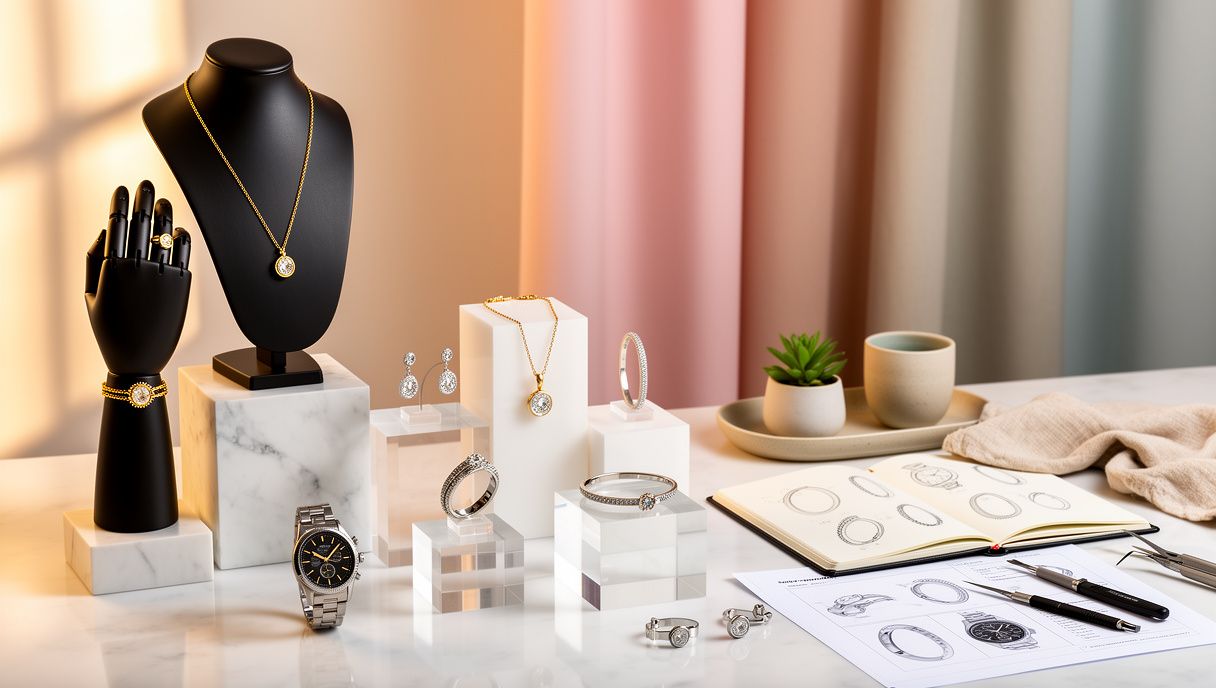
From Sketch to Storefront: A Practical Workflow That Scales
A reliable workflow is crucial when collections include dozens or hundreds of SKUs. The modern path begins with asset intake—CAD files, sketches, or clean product photos. CAD imports preserve scale and geometry, allowing the software to assign metal and gemstone properties for accurate reflections and dispersion. When working from photos, smart masking separates the piece from the background and rebuilds depth information to enable realistic relighting and shadow control. Either way, the system prepares a faithful base model for creative production.
Next comes studio setup. Instead of hauling lights and scrims, teams open a drag-and-drop studio designed for jewellery. Preloaded lighting profiles handle common use cases—white background packshots for marketplaces, soft lifestyle scenes for brand campaigns, or high-contrast setups that highlight facets in pavé. Users can tweak intensity, direction, and softness, then save those adjustments as presets to standardise results across launches and regional teams. Material panes let designers dial in metal roughness, stone brilliance, and prong edge sharpness, keeping macro fidelity intact for extreme zooms and 4K crops.
On-model visuals are where AI saves enormous time. The tool aligns rings to realistic finger poses, bracelets to natural wrist contours, and necklaces to varying necklines while preserving correct scale. Skin tone options, hand and face models, and wardrobe choices reflect audience diversity without the complexity of a live shoot. For lifestyle compositions, brands can drop the hero piece into curated environments—studio plinths, marble slabs, editorial flats—while controlling depth of field and shadow quality. Because everything is nondestructive, art directors can iterate styling choices in minutes and compare versions side by side.
Finally, output and deployment should be seamless. Teams export in channel-ready formats—transparent PNGs for e‑commerce, JPEGs for social, TIFFs for print—at 2K and 4K. Cropping templates keep consistency for PDPs, hero banners, email modules, and marketplace standards like 85% product occupancy on white. Metadata can be embedded or exported for PIM and DAM systems, preserving SKU, variant, and usage rights information. By centralising presets and style guides, a jewellery content creation tool makes it realistic to maintain a unified look across geographies and campaign types.
Choosing the right platform matters. Look for CAD compatibility, advanced lighting control, fine-grain material editing, and efficient batch rendering. A solution like a dedicated Jewellery content creation tool brings these capabilities together, enabling fast turnarounds without compromising photorealism. For growing brands, the ability to move from design concept to storefront-ready assets in the same system is a strategic advantage that shortens time-to-market and protects creative quality as teams scale.
Real-World Scenarios: How Different Jewellery Businesses Win
Independent artisans often face the biggest production bottlenecks. A single collection might require dozens of packshots, colourways, and lifestyle images to satisfy a website, Etsy or marketplace listing, Instagram carousel, and a small print catalogue. With a jewellery content creation tool, a designer can import a CAD of a new pendant, generate realistic metal and gemstone variants, and build a coordinated set of visuals in a day. Pre-order pages go live earlier, helping fund production and gauge demand. Because the imagery is consistent and true to scale, returns drop from mismatched expectations, and customers feel confident about stones, settings, and proportions.
For multi-brand retailers, assortment breadth creates a different challenge: how to maintain visual consistency when assets come from dozens of vendors. Centralised presets ensure lighting and background standards hold across product lines. Rings, earrings, bracelets, and watches can be normalised into a shared visual language for the homepage, search results, and PDPs. The same system can produce trend-focused lifestyle shots that combine multiple pieces, opening up cross-selling opportunities. Retailers also benefit from rapid localisation: seasonal backdrops for different regions, on-model tones reflecting diverse audiences, and copy-safe compositions for translated layouts—all without rebooking a studio in each market.
Established luxury houses gain strategic flexibility. Creative teams can test campaign concepts months before samples arrive by using concept-to-reality tools. A single hero design becomes the centrepiece of multiple narratives: a high-gloss editorial set for print, a refined still life for window displays, and a subdued packshot suite for wholesale partners. On-model imagery can be diversified quickly—age, skin tone, styling—ensuring inclusivity across global channels. For heritage lines, archival pieces can be reimagined in new contexts while preserving material fidelity, thanks to precise metal finishing and gemstone dispersion controls. In all cases, 2K and 4K outputs future‑proof assets for high-resolution displays and luxury print.
Marketing and performance teams see measurable lifts. Faster production enables more frequent A/B tests: alternative crops, lighting angles that emphasise facets, or background hues that align with seasonal campaigns. Social teams can build platform-specific variations—vertical, square, and landscape—without compromising clarity. When PDPs add zoomable 4K crops, click-to-zoom interactions increase, session times rise, and conversion often follows. Consistent white-background assets that meet marketplace specifications reduce listing rejections and speed up approvals. Because everything is generated within a controlled environment, colour accuracy remains trustworthy across devices, which improves customer satisfaction and reduces post-purchase disappointment.
Sustainability and cost control are additional advantages. Fewer physical shoots mean less shipping, travel, and material waste from set builds. Production budgets stretch further by replacing repeat studio days with virtual iterations, freeing resources for strategic media placements or influencer partnerships. Internally, creative bandwidth expands; rather than managing logistics, teams spend time on higher-level storytelling—cohesive collections, editorial themes, and product education. The net result is a virtuous cycle: faster launches, stronger brand consistency, better customer experience, and more efficient operations—all driven by the precision and scalability of an AI-powered jewellery content creation tool.

Casablanca data-journalist embedded in Toronto’s fintech corridor. Leyla deciphers open-banking APIs, Moroccan Andalusian music, and snow-cycling techniques. She DJ-streams gnawa-meets-synthwave sets after deadline sprints.

Leave a Reply